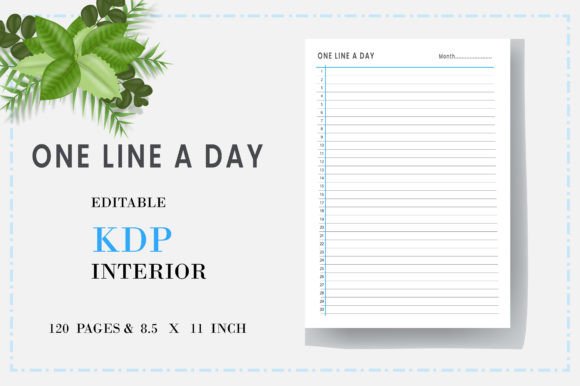
The Rise of One Line a Day Journals and the KDP Publishing Opportunity
In a world saturated with information and endless digital notifications, a quiet counter-trend is gaining momentum: the practice of micro-journaling. At the forefront is the One Line a Day journal, a minimalist yet profound tool for capturing life's essence. This simple concept—committing to a single line of reflection each day—has evolved from a personal habit into a significant product category, particularly for savvy entrepreneurs in the self-publishing space. For Amazon KDP (Kindle Direct Publishing) sellers, high-quality, print-ready interiors dedicated to this format represent not just a product, but a strategic alignment with contemporary consumer needs.
Understanding the One Line a Day Phenomenon
A One Line a Day journal is, structurally, a five-year diary. Each page is dedicated to a single date, divided into five sections, allowing the user to write a brief entry for that same date over five consecutive years. This design transforms journaling from an intimidating, time-consuming task into an accessible, sustainable ritual. The psychological benefit is profound; it encourages consistency without overwhelm, creating a tangible record of personal growth, change, and recurring patterns over time. This format respects the modern individual's constraints while offering deep retrospective value.
Aligning with Macro Trends in Lifestyle and Productivity
The resurgence of analog tools like the One Line a Day journal intersects with several dominant trends. First is the growing emphasis on mental wellness and mindful living. As digital burnout increases, people are seeking anchored, tactile practices that promote presence. Writing a single line forces a moment of daily distillation, a cognitive pause that is inherently mindful.
Second, it aligns with the productivity and personal optimization market, but from a humane perspective. Unlike complex apps demanding data input, this journal offers a frictionless system for tracking goals, moods, or inspirations. It serves what today's professionals and creators need: a low-effort, high-yield organizational tool that integrates seamlessly into busy workflows.
Finally, it taps into the desire for legacy and tangible memory. In an ephemeral digital culture, physical objects that accumulate meaning over years become cherished artifacts. A five-year journal becomes a family heirloom, a record of a business's evolution, or a creative's idea log. This meets a changing consumer preference for products that offer lasting emotional value over disposable utility.
Why KDP Sellers Should Pay Attention
For entrepreneurs using Amazon's KDP platform, this trend opens a substantial opportunity. The market for niche journals and planners is robust, but success increasingly depends on quality and specialization. A generic notebook interior is less competitive; a thoughtfully designed One Line a Day interior that is high-resolution and print-ready addresses a specific, engaged audience.
The changing needs of KDP sellers themselves mirror this. The expectation has moved beyond simply having a PDF file. Sellers now require fully editable source files, like Illustrator AI files, to enable customization for different audiences—perhaps a "One Line a Day for Entrepreneurs" or a "Gratitude One Line a Day" variant. This flexibility is crucial for scaling a product line and responding to micro-trends.
Furthermore, the technical specifications matter profoundly. A design built for Letter Size paper (11" x 8.5" Inch) with no bleed simplifies the printing process and ensures consistency. When a product is advertised as 100% ready for upload to KDP, it drastically reduces the technical barrier for sellers, allowing marketers, freelancers, and enthusiasts to focus on promotion and branding rather than graphic design troubleshooting.
The Practical Advantage of Professional Interiors
Consider a professional looking to launch a side business on KDP. They identify the demand for mindfulness products. A search reveals countless journal options. The differentiating factor becomes interior design and file utility. A package that includes:
- An editable Illustrator AI file for full customization.
- High-resolution PDF files for flawless print.
- A 120-page design optimized for the five-year structure.
- A clean, no-bleed layout for straightforward KDP upload.
This package is not merely a template; it is a business accelerator. It allows the seller to deploy a market-ready product in hours, not weeks. The inclusion of editable files means they can iterate quickly, test covers, adjust wording, or create complementary products, thereby building a cohesive brand in a lucrative niche.
Connecting to Larger Developments in Creative Entrepreneurship
The accessibility of tools like these reflects the broader democratization of publishing and product creation. Technology has enabled platforms like KDP, but the true game-changing element is the availability of professional-grade assets that bridge the skill gap. A high-resolution, print-ready interior for a One Line a Day journal empowers the non-designer. It aligns with the macro-development where content and community are king, but production quality is the necessary foundation.
Observations from successful KDP marketplaces show that products tied to specific practices—like micro-journaling—often cultivate stronger customer loyalty. Users who buy a specialized journal are more likely to seek out related content (blogs, communities) and repeat purchases (different cover designs, themed versions). This creates a sustainable business model for the seller beyond a single transaction.
In essence, the One Line a Day journal interior is more than a set of files. It is a key that unlocks a product perfectly synchronized with contemporary desires for simplicity, reflection, and tangible legacy. For the KDP seller, it represents a pragmatic entry into a growing market with a product that has inherent depth and utility. By leveraging such ready-made, high-quality assets, entrepreneurs can focus on what they excel at: marketing, storytelling, and building a brand around the meaningful practice of capturing one line, each day, for years to come.