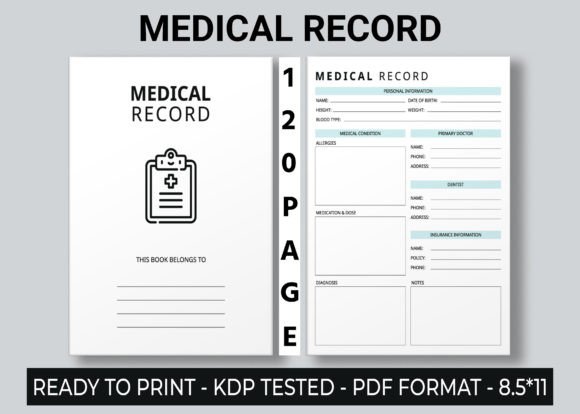
The Medical Record KDP Interior: Your Blueprint for Creating Personal Health Journals
If you're exploring self-publishing, you might have stumbled across the term "KDP interior" or "POD interior." These are the pre-designed, digital files that form the inside of your book—the pages you fill with content. A specific type, the Medical Record KDP Interior, is a specialized template crafted for a unique and increasingly popular niche: personal health journals and record-keeping books.
What Exactly Is a Medical Record KDP Interior?
Think of it as a ready-made skeleton for a book, designed exclusively for tracking health information. Instead of starting from a blank page and wrestling with formatting margins, page numbers, and section layouts, you receive a complete digital file package. This package is pre-formatted to industry standards, tested for compatibility with Amazon's Kindle Direct Publishing (KDP) platform, and structured with pages intuitively organized for medical logging. It’s a foundational tool that removes the technical guesswork from publishing, allowing you to focus entirely on creating a useful product.
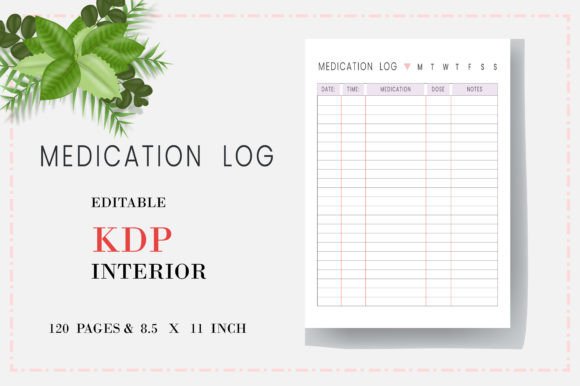
The typical Medical Record KDP Interior bundle includes editable source files (like AI for Adobe Illustrator), high-resolution PDFs for professional printing, PNG images, and is set to the standard US book size of 8.5 x 11 inches. Crucially, it includes "bleed"—a technical printing term ensuring backgrounds or borders run flawlessly to the edge of the page without white strips. With 120 total pages, including introductory sections, it's a substantial framework ready for you to customize and upload directly.
Real-World Uses: Who Needs a Personal Health Journal Template?
The application of a Medical Record KDP Interior goes far beyond a single use case. It serves as a springboard for creators, healthcare professionals, caregivers, and individuals wanting to produce tangible tools for managing health.
For Self-Publishing Authors and Health Coaches
Imagine a nutritionist who wants to offer clients a complementary physical journal to accompany their online program. Instead of hiring a graphic designer, they can use the editable AI file to insert their branding, modify section headers, and populate pages with specific tracking fields for meal plans, hydration, and symptom logs. They create a professional, cohesive product that reinforces their authority and provides clients with a structured offline tool.
For Caregivers and Patient Advocates
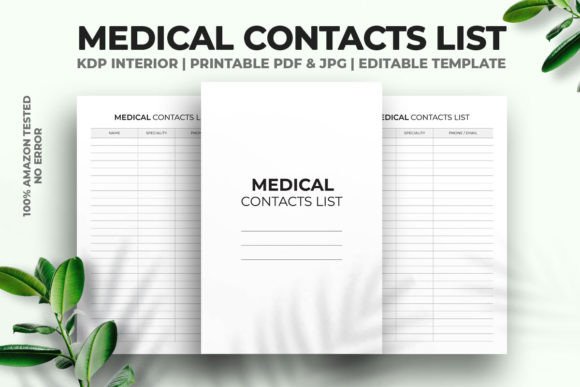
Managing the care of a loved one, especially with a chronic condition, involves a flood of information: doctor appointments, medication schedules, test results, and observed symptoms. A caregiver can use this KDP interior to create a customized "Caregiver's Log Book." They can add pages for emergency contact lists, insurance details, and daily observation charts. Printing a few copies provides a centralized, reliable system that multiple family members can use, reducing stress and improving care coordination.
For Chronic Condition Management Communities
Individuals managing diabetes, hypertension, autoimmune disorders, or mental health conditions often benefit from consistent tracking. A support group leader or a blogger within these communities could use the template to publish a tailored "Diabetes Management Journal" or "Mental Wellness Tracker." By selling or sharing these books, they provide a valuable resource to their community, fostering engagement and offering a practical tool that complements digital apps.
For Educational and Medical Practitioners
A physical therapist might design a "Rehabilitation Progress Journal" for patients to record exercise adherence, pain levels, and mobility improvements. A clinic could produce a simple "Pre-Surgery Preparation and Recovery Log" to give patients, ensuring they follow pre-op instructions and track post-op healing. These professionally printed books enhance patient education, adherence, and the overall service experience.
Key Considerations Before Using a Pre-made Interior
While a Medical Record KDP Interior dramatically simplifies the production process, successful use depends on a few practical assessments.
First, consider your customization level. The included editable AI file is powerful, but requires access to and basic knowledge of Adobe Illustrator or similar vector software. If you lack this, the high-resolution PDF and PNG files still allow for less granular adjustments using other tools, but deep structural changes become harder. Your technical comfort zone matters.
Second, audience alignment is crucial. The 120-page structure is a foundation. You need to evaluate if the pre-defined section flow—likely starting with introductory pages, then moving to detailed logging pages—matches the user journey you envision. Perhaps your concept requires more front-matter educational content or different data categories. You'll need to plan how to adapt the template to your specific audience's needs.
Third, think about distribution and scale. KDP and other Print-on-Demand services are ideal for low-inventory, direct-to-consumer sales. If you plan to print large batches locally for distribution at workshops or clinics, the provided high-resolution print-ready PDFs are perfect. But confirm the print specifications (like bleed and trim) align with your local printer's requirements.
Strengths and Natural Limitations
The primary strength of a Medical Record KDP Interior is its time-to-market efficiency. It converts the complex, often tedious process of book formatting into a simple customization task. It's also KDP tested, meaning the upload process should be smooth, avoiding common rejection reasons related to file specifications. For anyone without advanced graphic design skills, it's a democratizing tool that enables professional output.
A potential limitation lies in its specialized nature. It is optimized for medical and health record-keeping. If your book idea straddles multiple genres—say, a health journal combined with a recipe book—you may find the structure too rigid and need to integrate additional templates or do more extensive editing. Also, while "bleed ready" is a significant professional feature, it's essential only if your design includes full-page backgrounds or colored edges. For a simpler, white-page journal with only text and lines, bleed is less critical.
Bringing Your Concept to Life
Start by mapping out the user's experience. Sketch what a person would need to record on a daily, weekly, and monthly basis. Then, open the provided files and see how the existing pages can be adapted. Perhaps the "Intro page" becomes a detailed user guide. Maybe you group certain logging pages together to create a dedicated "Monthly Review" section. The template is your clay; your understanding of the end-user's need shapes the final product.
Observing trends in health self-management reveals a gap: many people are overwhelmed by disparate digital apps and handwritten notes. A well-designed, physical journal created from a reliable Medical Record KDP Interior offers consolidation, focus, and a tangible sense of control. It turns data tracking into a purposeful ritual. Whether you're publishing for a niche audience, supporting a community, or enhancing your professional services, this digital file package is more than just a layout—it's a shortcut to creating something genuinely helpful in the real world.