The Mood Journal Mental Health Tracker: A Strategic Tool for Clarity and Decision-Making
For professionals, entrepreneurs, creators, and anyone navigating a demanding life, mental clarity is not just a personal luxury—it’s a strategic asset. The Mood Journal Mental Health Tracker moves beyond the concept of a simple diary. It is a structured, editable tool designed to transform subjective emotional experience into objective data. This data, when reviewed thoughtfully, becomes a powerful foundation for better planning, sharper communication, enhanced creativity, and ultimately, more consistent results in both personal and professional realms.
Beyond Self-Care: The Operational Value of Tracking Your Mood
Why would a busy marketer, a small business owner, or a freelancer invest time in a daily mood log? The answer lies in the intersection of emotional awareness and operational effectiveness. Our emotional states directly influence our decision-making bandwidth, our creative output, our resilience in negotiations, and our capacity for focused work. The Mood Journal Mental Health Tracker provides a systematic method to capture these states. By logging not just mood but often the correlating factors—sleep, stressors, achievements—you begin to map patterns. This map reveals your personal operational rhythms: when you are most strategic, when you are most vulnerable to distraction, and what triggers elevate or diminish your performance.
Consider a common scenario: an entrepreneur facing a week of critical client pitches. Using the Daily Mood Journal Logbook proactively, she notes that her confidence and articulation peak on days following a morning routine involving planning and light exercise. Conversely, she identifies that back-to-back administrative tasks before a meeting often lead to a frazzled, less persuasive state. This isn’t merely introspection; it’s actionable intelligence. With it, she can strategically schedule her week, placing high-stakes meetings after her peak-condition routines and blocking administrative work for different times. The journal becomes a planning aid rooted in empirical self-knowledge.
The Unique Advantage of an Editable, Tailored Format
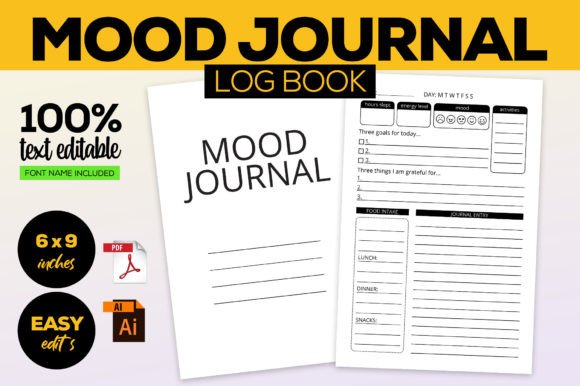
The utility of any tool is magnified when it can be adapted to fit the user’s specific context. The Unique Editable format of this Mood Journal Mental Health Tracker is a core feature that elevates its strategic value. The provided AI and high-resolution PDF files are designed for customization. You can change fonts, adjust section headings, or even modify the layout to prioritize the metrics most relevant to your goals. A blogger tracking creativity might add a section for “idea flow” ratings. A project manager might integrate a simple scale for “team collaboration satisfaction” alongside personal mood.
This editability means the tool avoids being a generic, prescriptive template. It becomes a bespoke instrument. For the educator, it could be tailored to track mood in relation to classroom engagement and lesson planning stamina. For the freelancer, it could correlate mood with client interaction outcomes and financial milestones. The 110-page, print-ready PDF offers ample space for long-term tracking, allowing for quarterly or annual reviews that reveal macro-trends essential for long-term career or life planning. The ability to own and adapt the file ensures the journal works for you, not the other way around.
Practical Implementation: How to Approach Your Mood Journal Strategically
To extract maximum value, approach the Mood Journal Mental Health Tracker with intention. Random, sporadic entries will yield little insight. Treat its use as a brief, focused operational debrief, ideally at a consistent time each day.
Define Your Tracking Objectives
Before you begin, ask: what operational or personal goal is this serving? Are you seeking to stabilize your creative output? Improve your decision-making in high-pressure situations? Enhance your leadership communication? Your objective will shape what you pay attention to. The journal’s framework supports noting mood, but your focused intent will guide you to log the accompanying details—the project you were working on, the conversation you had, the market news you read—that give the mood data its context.
Review Periodically for Pattern Analysis
The daily act of logging is data collection. The weekly or monthly review is where strategy is born. Set time every few weeks to scan your entries. Look for clusters: what activities consistently align with positive, productive moods? What triggers precede downturns in focus or motivation? These patterns are your personal performance indicators. They allow you to make informed adjustments to your schedule, your commitments, and even your business or creative processes.
Integrate Findings into Your Planning Systems
The insights from your Daily Mood Journal Logbook should feed directly into your existing calendars, project plans, or goal-setting frameworks. If you identify that your strategic thinking is clearest in the late afternoon, protect that time for planning work. If client calls on Mondays consistently lead to elevated stress, consider restructuring your client communication schedule. The journal becomes a feedback loop, informing and refining your operational tactics.
Risks and Considerations: Avoiding Superficial Use
Without clear goals, mood tracking can become an unproductive exercise or even a source of undue fixation. The primary risk is using the Mood Journal Mental Health Tracker as merely a record of complaints or fleeting feelings, without engaging in the analytical step. Another consideration is the need for honesty without judgment. The tool is for observation, not self-critique. Its purpose is to illuminate patterns so you can work with your nature, not against it.
Furthermore, while the tool is powerful, it is not a substitute for professional mental health care when needed. For entrepreneurs and professionals under significant stress, the journal might reveal persistent patterns of anxiety or low mood that warrant seeking additional support. In that case, the journal serves as a valuable, documented record that can provide clarity in professional consultations.
Long-Term Value for Branding, Creativity, and Customer Experience
The implications of sustained self-awareness extend outward. For the creator or business owner, your internal state inevitably influences your external output. A designer who understands the conditions that foster her best creative work can better manage her workflow and client deadlines, leading to a more reliable and strong brand reputation. A business leader who can anticipate his own reactive moods can prepare for difficult negotiations or team conflicts, resulting in more stable operations and a better experience for his team and customers.
Over months and years, the accumulated data from your 110-page Mood Journal Mental Health Tracker becomes a unique autobiography of your professional evolution. You can see not just how you felt, but how you grew, adapted, and learned to navigate challenges. This long-term perspective is invaluable for making strategic life and career decisions, such as considering a new venture, changing a business model, or pivoting a creative direction. It grounds these big decisions in a deep understanding of your own sustainable working patterns.
Making It Your Own: The Final Strategic Step
The high-quality, editable PDF format is an invitation to take ownership. Don’t just use the journal as provided. Experiment with its structure. After a month of use, you might find you want to add a section for tracking energy levels alongside mood, or a quick note on the single most important decision you made that day. This iterative customization ensures the tool remains relevant and grows with you. The 300 DPI, print-ready file ensures that whether you use it digitally or choose to print it for tactile use, the quality supports a professional, durable practice.
In a world of constant input and demand, the Mood Journal Mental Health Tracker offers a disciplined pause for output—output of your own internal data. By converting experience into information, you equip yourself to make decisions not from a place of reactive emotion, but from a place of informed self-knowledge. That is a strategic advantage no professional, creator, or decision-maker should overlook.