The Checkbook Register: A Process-Driven Tool for Modern Financial Management
At its core, a Checkbook Register is a structured record-keeping system for tracking financial transactions. While traditionally associated with manual checking accounts, its function as a sequential log of income and expenses makes it a versatile process tool. For individuals and small business owners, integrating a Checkbook Register into a financial workflow provides a clear, linear narrative of cash flow, serving as both a planning instrument and an audit trail. This move from a simple ledger to a central component in a broader financial process hinges on its compatibility with modern needs for organization, consistency, and long-term accountability.
Integrating the Register into Your Financial Workflow
The true power of a Checkbook Register is realized when it is positioned as an active, not a passive, element in your routine. Consider your financial management as a continuous cycle: planning (budgeting), execution (spending/earning), recording (logging), reconciliation (verifying), and analysis (reviewing). The Checkbook Register sits squarely at the recording and reconciliation stages, but its data directly feeds back into planning and analysis. Before a major project or purchase, reviewing your register gives a factual baseline of available funds. During a business quarter, diligent daily logging creates a real-time dataset. After a learning activity—like a financial literacy course—applying new principles to your register becomes the practical implementation.
Preparation and Compatibility with Digital Ecosystems
A successful integration starts with preparation. You must decide on the medium. While a physical notebook serves one purpose, a digital, editable file—like the high-resolution, print-ready interiors mentioned—offers different process advantages. An editable Illustrator AI file allows for customization to fit specific business categories or personal tracking needs before printing. This preparatory customization ensures the tool aligns perfectly with your existing categorization methods. Compatibility is key; the register should not feel like an alien object but a natural extension of your other tools. For many, a printed, bound register used alongside mobile banking apps creates a hybrid system: digital for speed, analog for deliberate reflection and permanent record.
Practical Implementation: From Passive Log to Active Management Tool
To elevate a Checkbook Register from a simple list to a management tool, its use must be intentional. Start by defining the transaction types you will log. Beyond checks and debits, include cash payments, digital transfers, and business invoices. This turns it into a comprehensive cash journal. Next, establish a daily or weekly logging ritual. This is the execution phase. The process-oriented user doesn't see this as tedious data entry but as a brief consolidation step, similar to updating a project management dashboard. The act of writing or typing each transaction reinforces awareness of spending habits.
The critical workflow integration point is reconciliation. Regularly compare your register entries against bank statements or accounting software summaries. This quality control step catches errors, ensures consistency, and validates the data's integrity. A well-maintained register becomes a trusted source, reducing the mental load during tax preparation or financial reviews. For freelancers and small business owners, this reconciliation process directly interacts with decisions about client invoicing and expense categorization, making the register a foundational asset for downstream tasks.
Organization and Long-Term Usability Factors
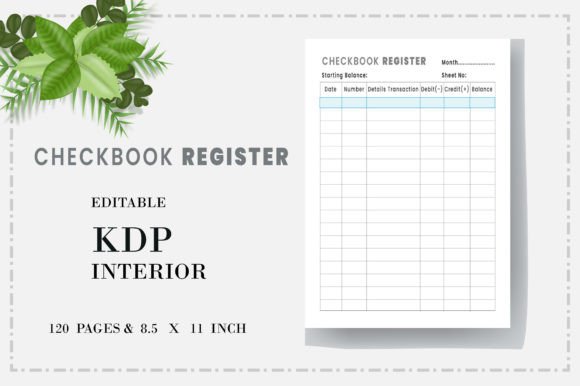
A 120-page design, formatted for Letter Size paper, is not just about volume; it's about enabling long-term organization. A single register can cover an entire fiscal quarter or year, providing a continuous, unbroken narrative. Features like "No Bleed" design ensure clean, professional entries when handwritten, supporting usability. The organization benefits are cumulative. Over time, you don't merely have a list of numbers; you have a chronological story of your financial operations. This historical record is invaluable for spotting trends, preparing for audits, or planning future business workflows. It interacts with your goal-setting processes by providing concrete historical data against which to measure progress.
Workflow Examples Across Different Audiences
The application of a Checkbook Register varies naturally across professions, but the underlying process remains similar.
- For the Entrepreneur/KDP Seller: Here, the register is a project-specific financial tracker. Before publishing a new book series, a dedicated register section can budget for cover design, marketing ads, and ISBN costs. During the campaign, every ad spend and sales platform fee is logged. After the launch, this data interacts with KDP royalty reports to calculate net profit, informing decisions on scaling or adjusting strategies. A fully editable, high-resolution PDF file, ready for upload to KDP, means the seller can also brand and sell this interior as a product, turning their own process tool into a business asset.
- For the Freelancer or Creative: The register becomes a client-project ledger. It tracks advances, milestone payments, and project-related expenses. This record interacts with contract terms and invoicing schedules, ensuring payments are claimed and expenses are recouped. Its usability during tax season is particularly high, as it provides organized evidence for deductions.
- For the Productivity-Minded Individual: It functions as a personal finance dashboard. Paired with a budgeting app, the register is the manual verification layer and the place for reflective notes on discretionary spending, aiding in behavioral change and long-term goal adherence.
Quality Control and Consistency Through Design
A print-ready, professionally designed interior contributes significantly to consistency and quality control. A clean, structured layout with clear column headings reduces entry errors and encourages complete data capture. This is not merely aesthetic; it's a usability feature that supports efficient execution. When a tool is easy and pleasant to use, the ritual of updating it is more sustainable. The "100 Ready for Upload KDP" feature speaks to its tested format, meaning the design has already undergone a quality check for commercial use, giving the user confidence in its robustness as a process component.
Moving Beyond Basic Tracking: The Register as a Decision-Support Asset
Ultimately, a process-driven Checkbook Register becomes a decision-support system. Its organized, chronological data provides the "why" behind financial decisions. When considering a new software subscription for your business, the register shows the current outflow for similar tools. When planning a marketing push, it reveals past campaign cost-effectiveness. This interaction with other decisions and resources makes it a central, albeit humble, hub in your operational ecosystem. It provides the factual groundwork upon which intuitive business choices are built, blending quantitative record-keeping with qualitative management.
Integration is about smooth adoption. Begin by pairing the register with one existing financial task—like tracking a single business account or personal discretionary fund. Use its editable features to tailor columns to that specific task. This focused start builds familiarity. Gradually expand its scope as the process habit solidifies. Observe how this dedicated logging creates clarity and reduces anxiety around money matters. The Checkbook Register, in its modern, adaptable form, is less about accounting and more about cultivating financial awareness and control—a game-changing interior for any process-minded individual's workflow.