Mastering Copperplate Calligraphy: The Role of Structured Blank Guidelines
The pursuit of elegant, flowing script draws countless individuals to copperplate calligraphy. This style, characterized by its delicate hairlines and dramatic shaded strokes, requires not just a skilled hand but a disciplined foundation. The foundational tool for building that discipline is a set of well-structured practice sheets. Specifically, blank copperplate calligraphy guidelines provide the invisible architecture upon which every letter is constructed, ensuring consistency, proper slant, and balanced proportions.
The Architectural Blueprint for Elegant Script
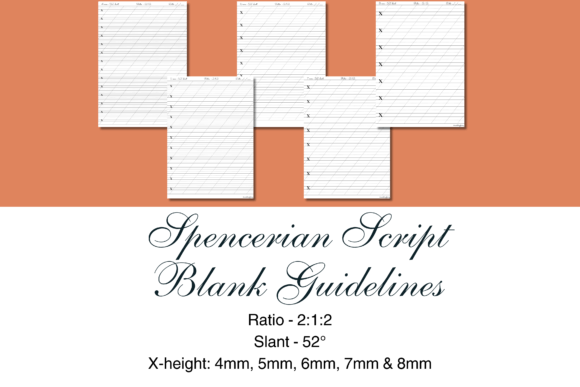
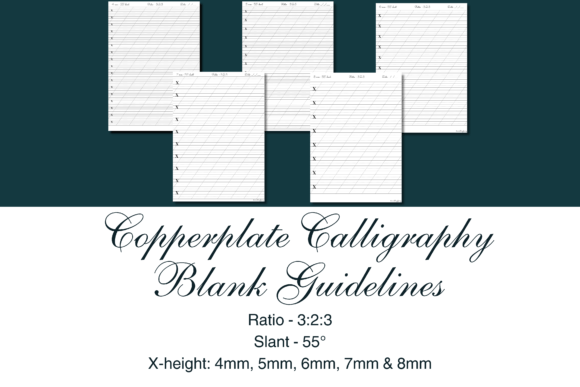
At its core, copperplate is a rhythmic dance of ascending and descending strokes. Without a guide, this dance can quickly become chaotic. Blank guidelines serve as the unchanging stage. The key feature of effective guidelines is the inclusion of a precise slant line, typically set at 55 degrees. This constant angle is non-negotiable for authentic copperplate; it dictates the inclination of every oval and the direction of every exit stroke. Practicing on a sheet without this slant line is akin to learning to write on a page that is subtly tilting, leading to inconsistent and unstable letterforms.
Furthermore, the concept of x-height is paramount. The x-height refers to the height of the main body of lowercase letters like ‘a’, ‘c’, or ‘x’. Having multiple x-height options, such as 4mm, 5mm, 6mm, 7mm, and 8mm, within a single set of blank copperplate calligraphy guidelines allows for adaptable practice. A smaller x-height, like 4mm, demands greater precision and control, excellent for refining minute details. A larger x-height, such as 8mm, encourages broader, more expressive movements and is ideal for working on compositional layout or for those using larger nibs.
Understanding the 3:2:3 Ratio System
A distinguishing characteristic of professional-grade practice sheets is adherence to a proportional ratio. The notation “3:2:3” describes a specific relationship between the different zones of a letter. If the x-height is assigned a value of 2 units, then the space allocated for ascenders (the tops of letters like ‘b’ and ‘h’) and descenders (the bottoms of letters like ‘g’ and ‘p’) measures 3 units each. This ratio creates a visual harmony across the script. Letters with ascenders and descenders gracefully extend without overpowering the core body of the text, maintaining an even, rhythmic flow across the line. Practicing on guidelines that enforce this ratio trains the eye and hand to automatically create this balance, which is essential for producing aesthetically pleasing paragraphs and compositions.
For everyday practice, the ability to switch between different x-heights within this proportional system is invaluable. A practitioner might start a session with 5mm guidelines to warm up, move to 7mm to focus on arm movement, and then return to 4mm to drill difficult letter combinations. This flexibility prevents monotony and addresses different skill development areas comprehensively.
Practical Applications and User Considerations
The utility of these digital resources extends across a wide spectrum of users. Educators integrating calligraphy into art or history curricula find that standardized blank copperplate calligraphy guidelines provide students with a clear, common framework, eliminating confusion over basic proportions and allowing instruction to focus on technique. Hobbyists and aspiring artists benefit from the structured yet blank canvas; the guidelines provide support without artistic constraint, letting creativity flourish within the boundaries of good form.
Professionals, such wedding stationery designers or logo artists, use these sheets for precise sketching and layout planning before committing to final materials. The non-physical, digital nature of the product—a downloadable PDF—is a significant advantage. Users can print the guidelines on their preferred paper stock, from smooth laser paper for fine nibs to textured watercolor paper for combined media projects. The A4 size ensures compatibility with standard home and office printers, making immediate practice accessible. The included files, one PDF with five distinct pages, organize the resource efficiently, allowing for easy selection and repeated printing of any specific x-height as needed.
Integrating Guidelines into a Development Workflow
Adopting these tools into a regular practice routine requires a mindful approach. It is recommended to begin with a single x-height, perhaps 6mm as a median point, and dedicate a session solely to maintaining consistent slant using the angled lines. The next session could focus on spacing, using the guidelines to ensure the distance between letters and words is uniform. Another practice might involve switching to the 8mm sheet to deliberately work on exaggerating ascender loops for dramatic effect, then switching to the 4mm sheet to control that exaggeration with precision.
An important observation is that the blank nature of the sheets—meaning they contain only the guideline structure and no sample letters—forces active learning. The practitioner must internalize letterforms and actively recall their construction, leading to deeper muscular and mental memorization than tracing over pre-written examples would provide. This aligns with the principle that true skill is built through autonomous, corrected repetition.
For researchers or historians studying historical documents, recreating scripts using period-accurate proportions can offer insights into the tools and techniques of the past. Using these guidelines with their defined ratio can help in creating faithful reproductions for analysis or demonstration.
The Long-Term Advantages of Structured Practice
The cumulative benefit of using standardized blank guidelines is the development of an internalized sense of proportion and slant. Initially, the practitioner is wholly dependent on the printed lines. Over time, however, the hand learns the feel of the 55-degree angle. The eye learns to gauge the 3:2:3 ratio spatially. This internal compass becomes the ultimate tool, allowing for confident freehand work on unlined paper or unconventional surfaces. The guidelines act as a training apparatus that, through consistent use, builds an independent skill.
Moreover, the availability of multiple x-heights in one package addresses the natural progression of a calligrapher. As control improves, the desire to create larger works or more minute details emerges. Rather than seeking out new resources, the practitioner can simply print a different page from the same set of blank copperplate calligraphy guidelines. This continuity supports seamless skill advancement.
In a broader sense, the discipline cultivated through this methodical practice transcends calligraphy. It reinforces virtues of patience, attention to detail, and incremental progress. The physical act of following these guidelines slows the mind and focuses concentration, offering a meditative reprieve from the pace of digital life. Whether the end goal is a handmade greeting card, a personalized gift, or a commercial art project, the journey is built on the reliable, repeatable foundation that only structured blank guidelines can provide.
Ultimately, these tools democratize high-quality practice. They remove the barrier of having to draw or measure personal guideline sheets, which is often tedious and error-prone. By providing a ready-made, professional architectural grid for the script, they ensure that every minute of practice is spent developing technique, not preparing the page. This efficiency is perhaps their greatest practical virtue for the busy modern creator, educator, or hobbyist seeking to master the timeless art of copperplate calligraphy.